No man is an island,
Entire of itself.
Each is a piece of the continent,
A part of the main.
If a clod be washed away by the sea,
Europe is the less.
As well as if a promontory were.
As well as if a manor of thine own
Or of thine friend's were.
Each man's death diminishes me,
For I am involved in mankind.
Therefore, send not to know
For whom the bell tolls,
It tolls for thee.
I now have three tattoos
Still I worry about those over-inked boys and girls
Never mind their over-inked mums and dads
Yet...
I now have three tattoos

I now have three tattoos
Yet mere blobs, I'm horrified by their appearance
My three micro-dots of cruel Suella
Yes...
I now have three tattoos

I now have three tattoos
Her face inked onto my body
Her brain targets for the radiographer
So...
I now have three tattoos

I now have three tattoos
Can off-setting work for Cruella?
Does helping me off-set a withdrawn lifebelt?
Hmm...
I now have three tattoos

I now have three tattoos
But the rest is a lie, I have three "x mark the spots."
And off-setting won't work, because she'd need to care.
Even though...
I now have three tattoos.

Yet, unknowingly, she may help save me;
Yet, knowingly, others are thrown into a watery abyss.
Stop the boats
Stop the waves
Waves of decency
Waves of duty
Duty of fairness
Duty of a Samaritan
Samaritan to stranger
Samaritan on a seashore
Seashore purgatorial
Seashore with white cliffs
Cliffs like a castle gate
Cliffs with parapets
Parapets armed
Parapets for boiling oil
Oil not to sooth
Oil to repel
Repel from me and you
Repel from my back yard
Yard chain furlong mile
Yard three shuffled feet
Feet shuffled from Africa
Feet now at the channel
Channel a step too far for Suella
Channel last ditch in the war
War for the Mail
War for the far right
Right rolled in a Saint George flag
Right but so so wrong
Wrong in thought
Wrong in deed
Deed unworthy
Deed so cruel
Cruel is her trait
Cruel as her blood
Blood that freezes
Blood so cold
Cold as stone
Cold as ice
Ice fields
Ice storms
Storms of lies
Storms to stop the boats
Boats of humans
Boats as necessary Arks
Ark for humanity
Ark with its dove
Dove of hope
Dove on a cross
Cross
Hope

Waves drown dove
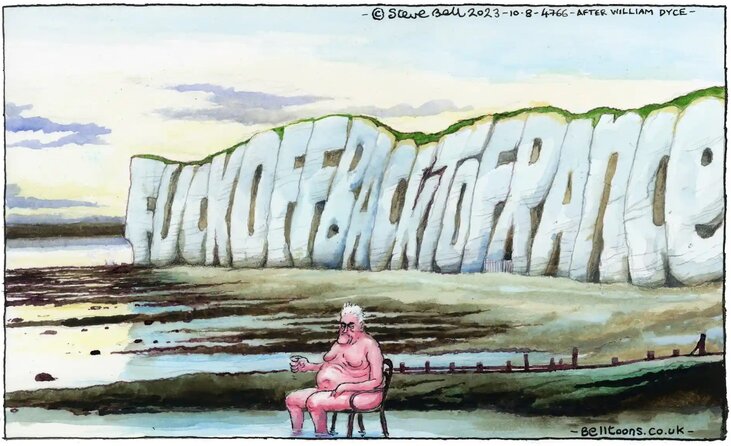
With thanks to the Wonderful Steve Bell and the Guardian. Re: Lee Anderson and the Bibby Stockholm barge.
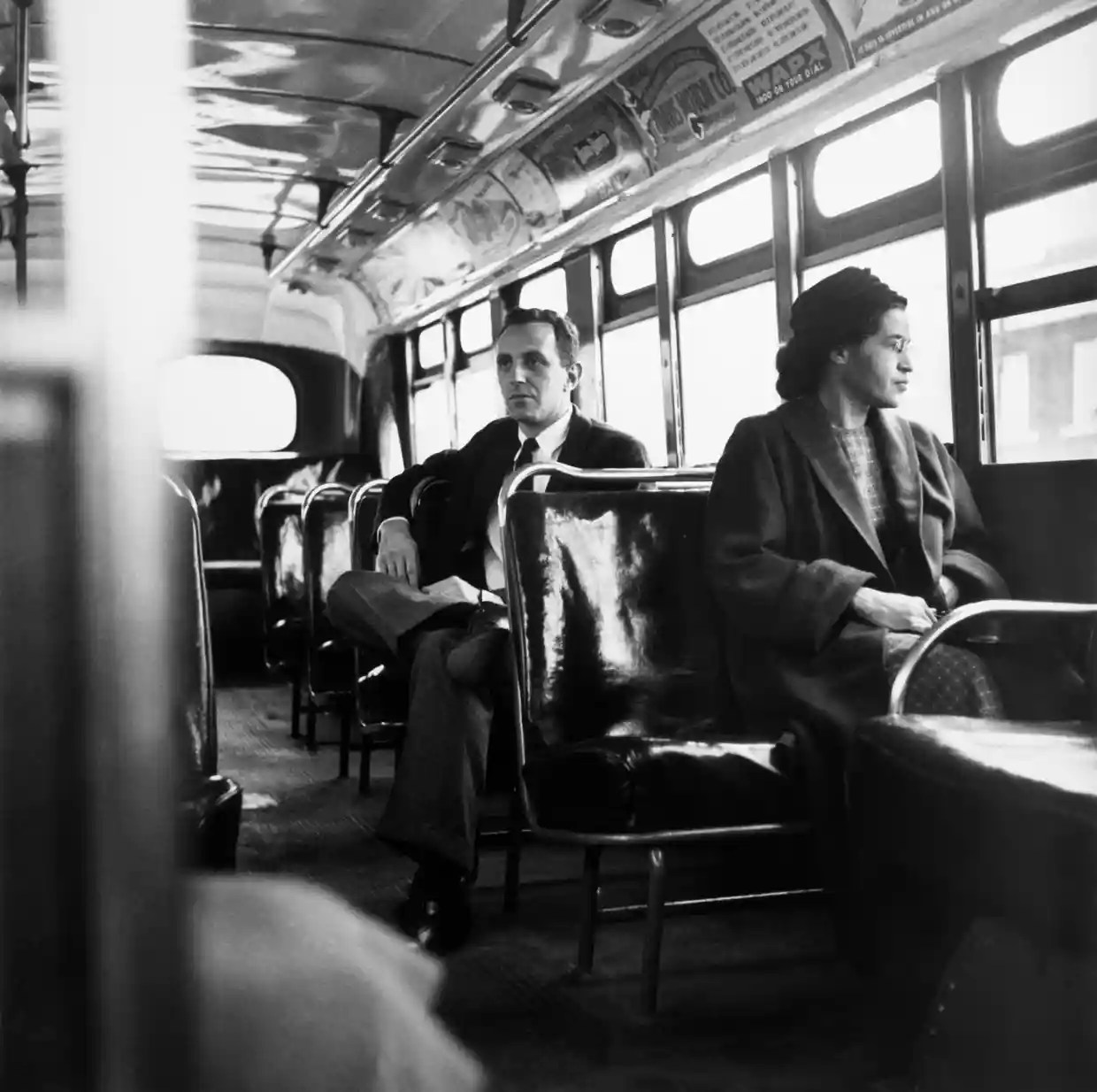
This was taken on 21 December 1956, the day of the desegregation of the public transportation system in Montgomery, Alabama. More than 12 months earlier, Rosa Parks had been arrested for refusing to give up her seat for a white man, sparking the 382-day Montgomery bus boycott – the first large-scale demonstration against segregation in the US. The white man in this photo was not a random passenger but veteran UPI reporter Nicholas Chriss: the shot was staged by an uncredited photographer to illustrate this important victory. GS
/
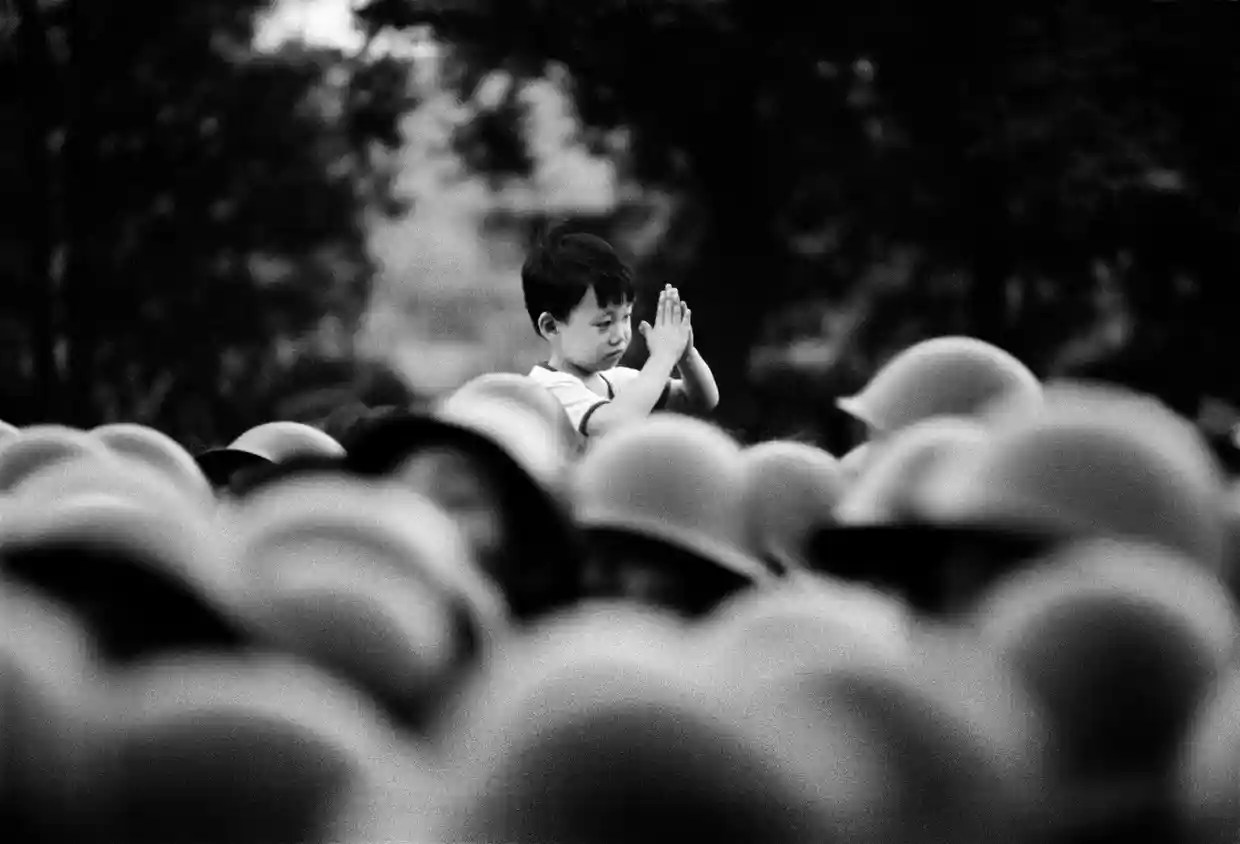
Tiananmen Square, 1989: a young boy …
“This was the only moment in my career when I instinctively knew it was going to be just fine – that I had a great shot,” Dario Mitidieri says. It was the Italian-born photojournalist’s final evening in Beijing, where he had flown to document the protests in the square. He had a return ticket to the UK the following morning.
When he first arrived in the Chinese capital, Mitidieri recalls that the atmosphere had been “quite joyful”. “It was like a massive student party, they were dancing in the streets at night, singing Chinese opera. We knew there were secret police filming everywhere but there was no sense of danger,” he says. But then soldiers began assembling around the square. Mitidieri’s photo of a young boy sitting on the shoulders of a relative, above a sea of helmets, was shot at around 6pm on 3 June 1989, only a couple of hours before the massacre began. In order to get the best angle, he climbed on to the seat of a nearby bicycle, held upright by two student protesters.
The image would become a potent symbol of the innocence of the protesters who were violently oppressed when the troops were sent in that night. Mitidieri, who never learned the name of the boy in the photo, thinks of his record of the events at Tiananmen Square as “a true example of the value of the work photojournalists do”. He compares it to the current situation in Ukraine: “We have this propaganda coming from the Russian government, but the rest of the world is very well aware of what’s going on because of the presence of photographers and journalists documenting it all, risking their lives.” GS
The Handmaids go to Washington, 2017
Is the dystopian future envisioned in The Handmaid’s Tale, Margaret Atwood’s novel turned TV show about a theocratic regime that strips women of their basic freedoms, already here? In recent years, the red cloaks and white bonnets worn by the handmaids of Gilead have become a familiar feature at protests on women’s issues around the world. The group of women standing outside the US Capitol in this image from 2017 were demonstrating against a bill that sought to defund the sexual healthcare provider Planned Parenthood. GS
Blessing the protesters at Euromaidan, 2014
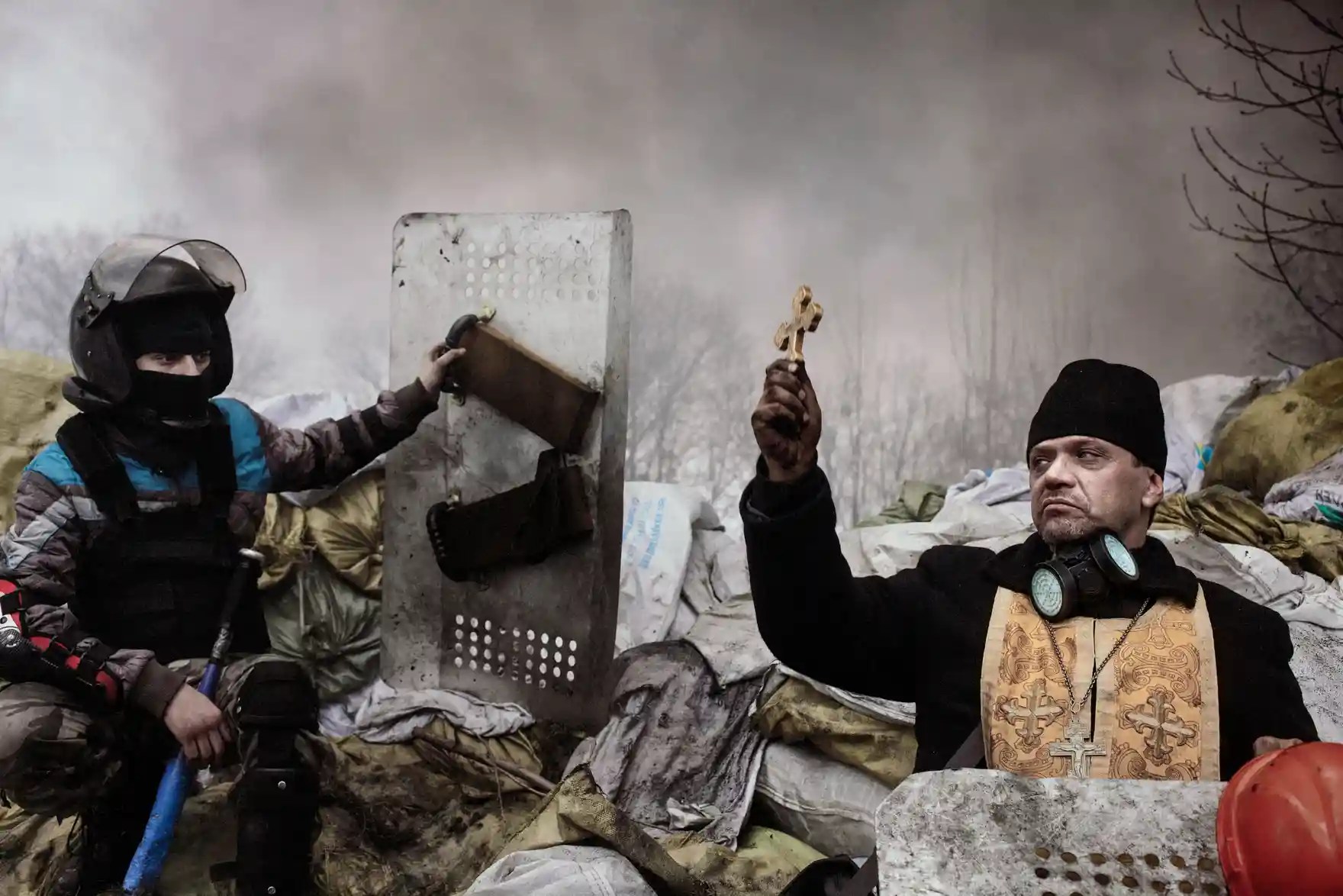
“Maidan was the first act in a great historical movement,” wrote Jérôme Sessini prophetically in 2019. “It was just the beginning of a coming confrontation on a much larger scale.” The Magnum photographer covered the protests in central Kyiv that led to the ousting of the pro-Russia president Viktor Yanukovych in 2014. Sessini was present during a period of extreme violence, when snipers killed at least 70 people; he captured the events with a series of extraordinarily dramatic and disturbing images. In this photograph, an Orthodox priest blesses the protesters on a barricade on 20 February 2014. FB
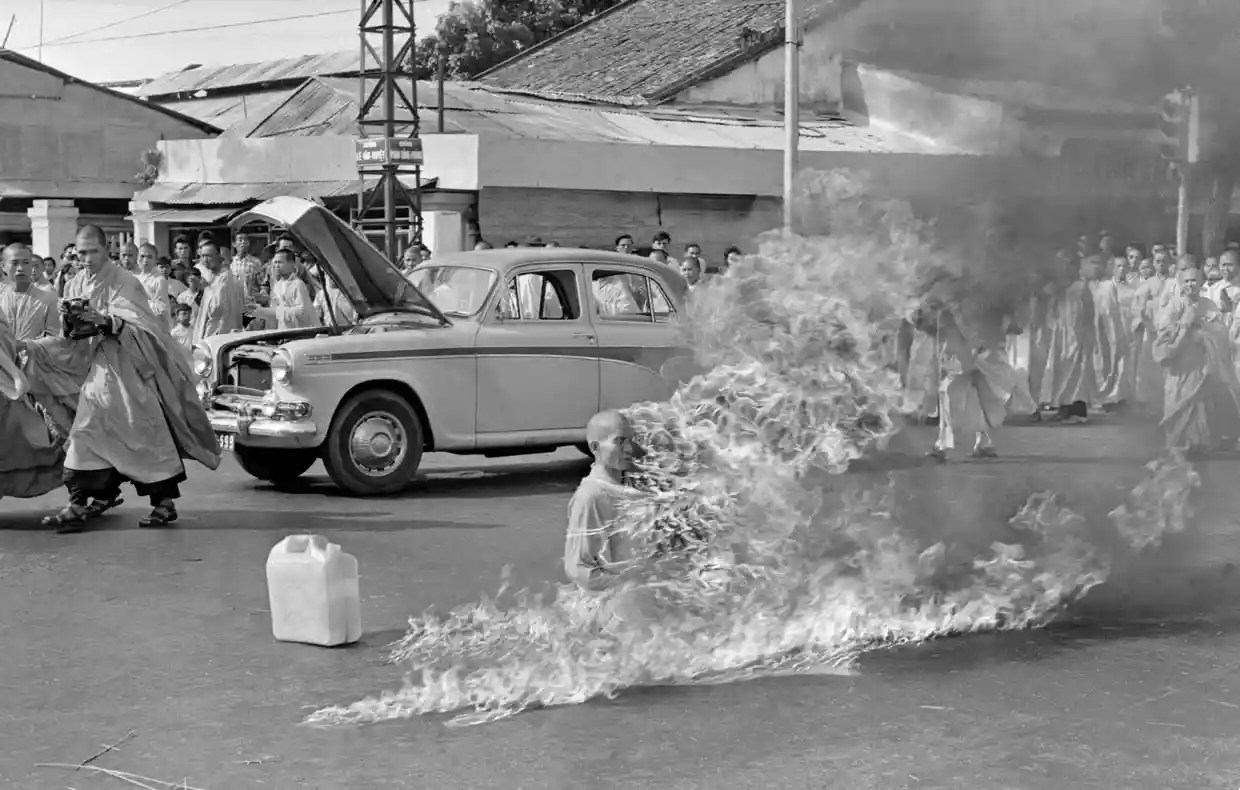
The self-immolation of Thich Quang Duc, 1963
“No news picture in history has generated so much emotion around the world as that one,” John F Kennedy said about this image of an elderly Buddhist monk taking his own life, on 11 June 1963, in protest against the persecution of Buddhists by South Vietnam’s largely Catholic government. American photojournalist Malcolm Browne won a Pulitzer prize for his documentation of the shocking event. GS
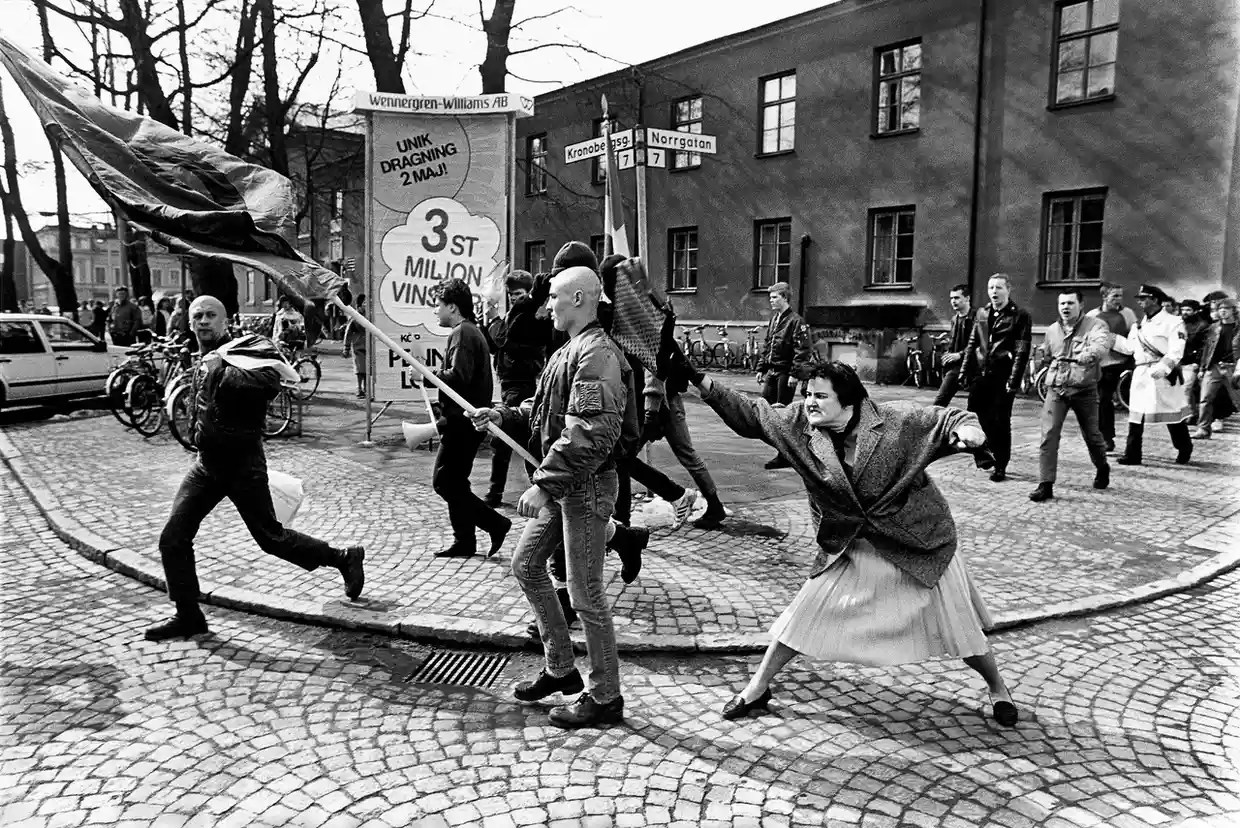
The woman with the handbag, 1985
A small neo-Nazi rally in the Swedish city of Växjö made worldwide news when this image of a woman striking a skinhead with her handbag began to circulate. Danuta Danielsson, a 38-year-old Jewish woman whose mother had survived the Holocaust, hijacked the demonstration by the Nordic Realm party on 13 April 1985, in an impulsive counterprotest that has since been memorialised in multiple statues. GS
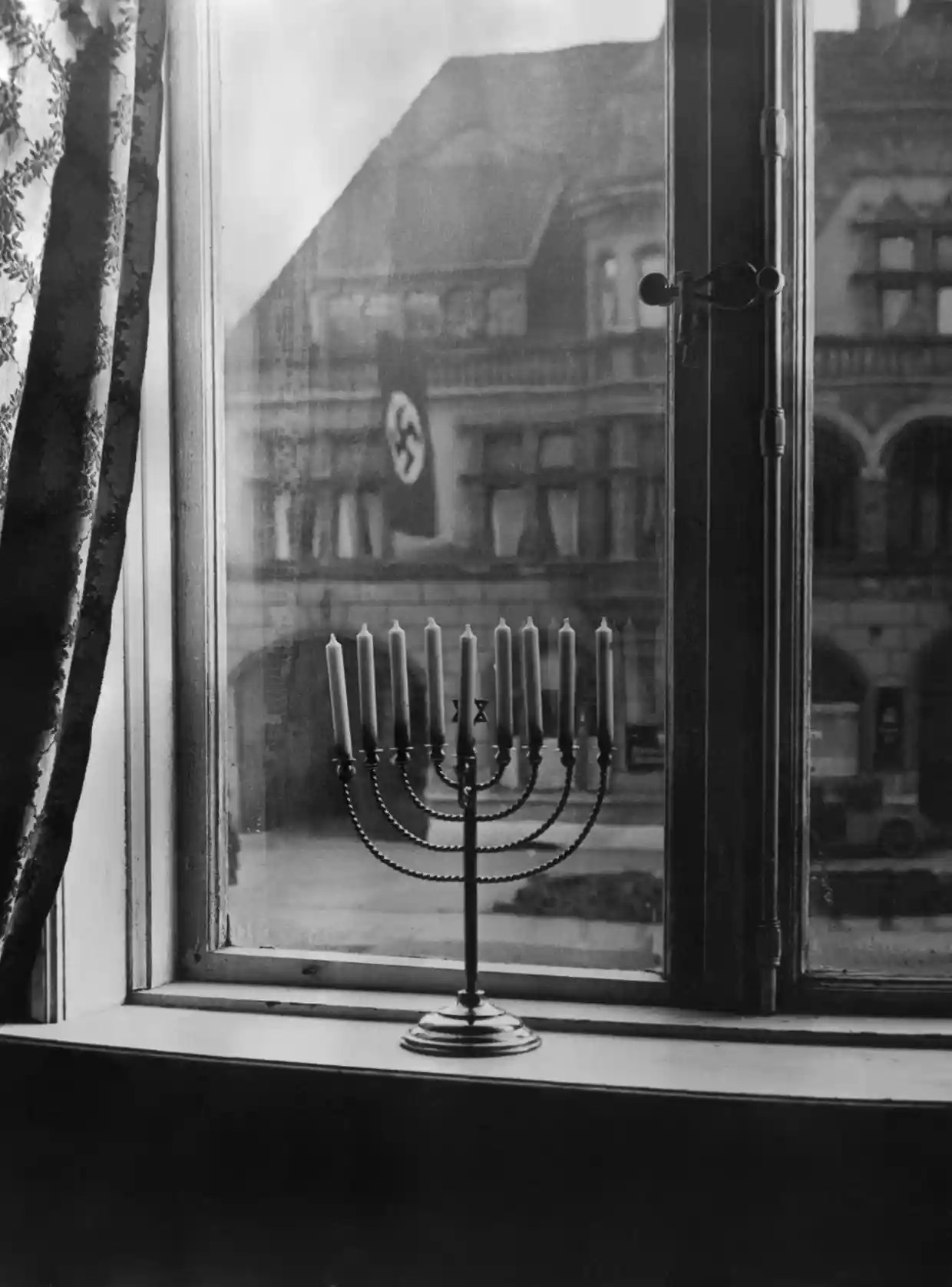
A defiant menorah, 1931
Rachel and Rabbi Dr Akiva Posner were a Jewish couple with three children, living in Kiel, Germany, in the early 1930s. As part of Hanukkah celebrations, the menorah must be prominently displayed; but it can be hidden during a time of persecution. Rachel documented the moment – just over a year before Hitler took power – when the rabbi defiantly lit their menorah in the window, facing a building decked with Nazi flags. The Posners fled Germany two years later. FB
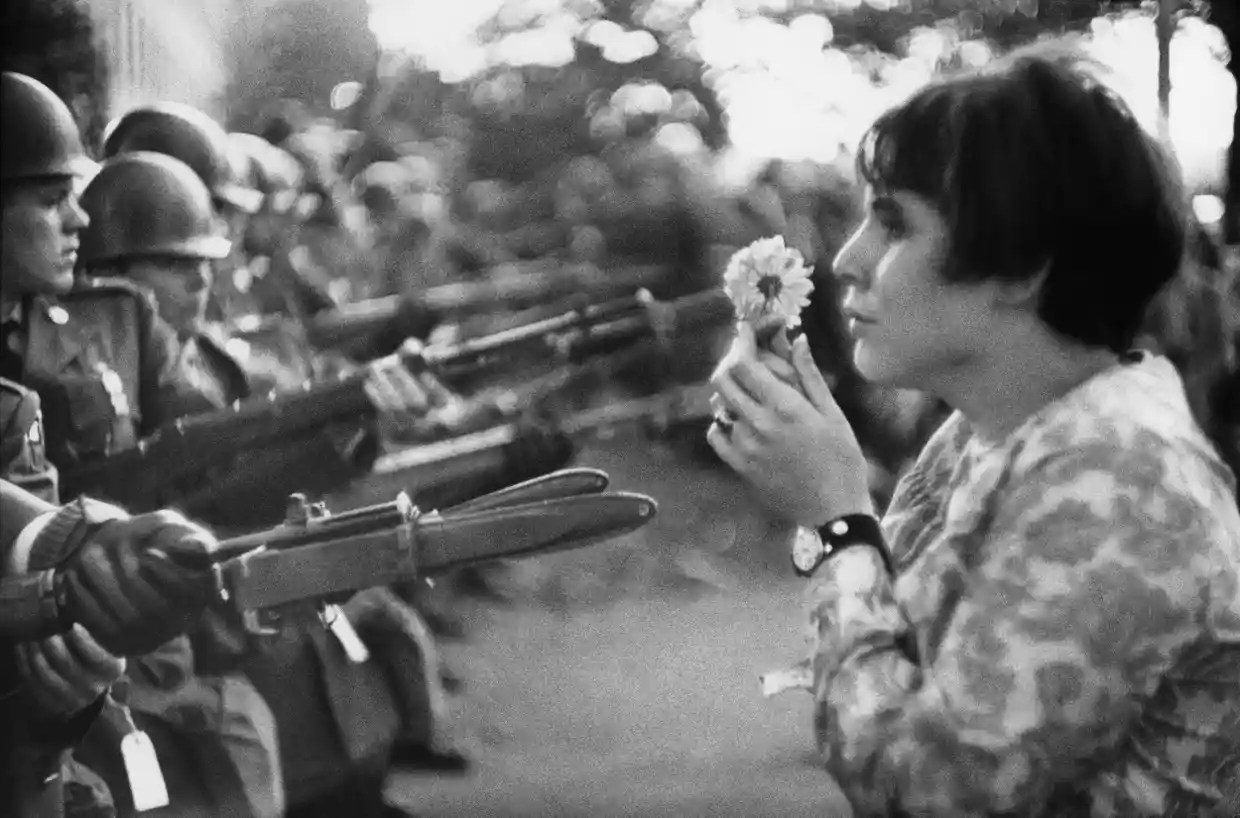
Jan Rose Kasmir plants a flower in a bayonet to protest against the Vietnam war, 1967
Jan Rose Kasmir, 17, holds a chrysanthemum before a row of bayonet-wielding soldiers. This shot was taken by the Magnum photographer Marc Riboud on 21 October 1967 at the March on the Pentagon, a rally in Washington DC attended by 100,000 anti-war protesters. It would become the defining image of that movement. The soldiers, Kasmir later said, “were just as much a victim of the war machine as anyone else”. GS
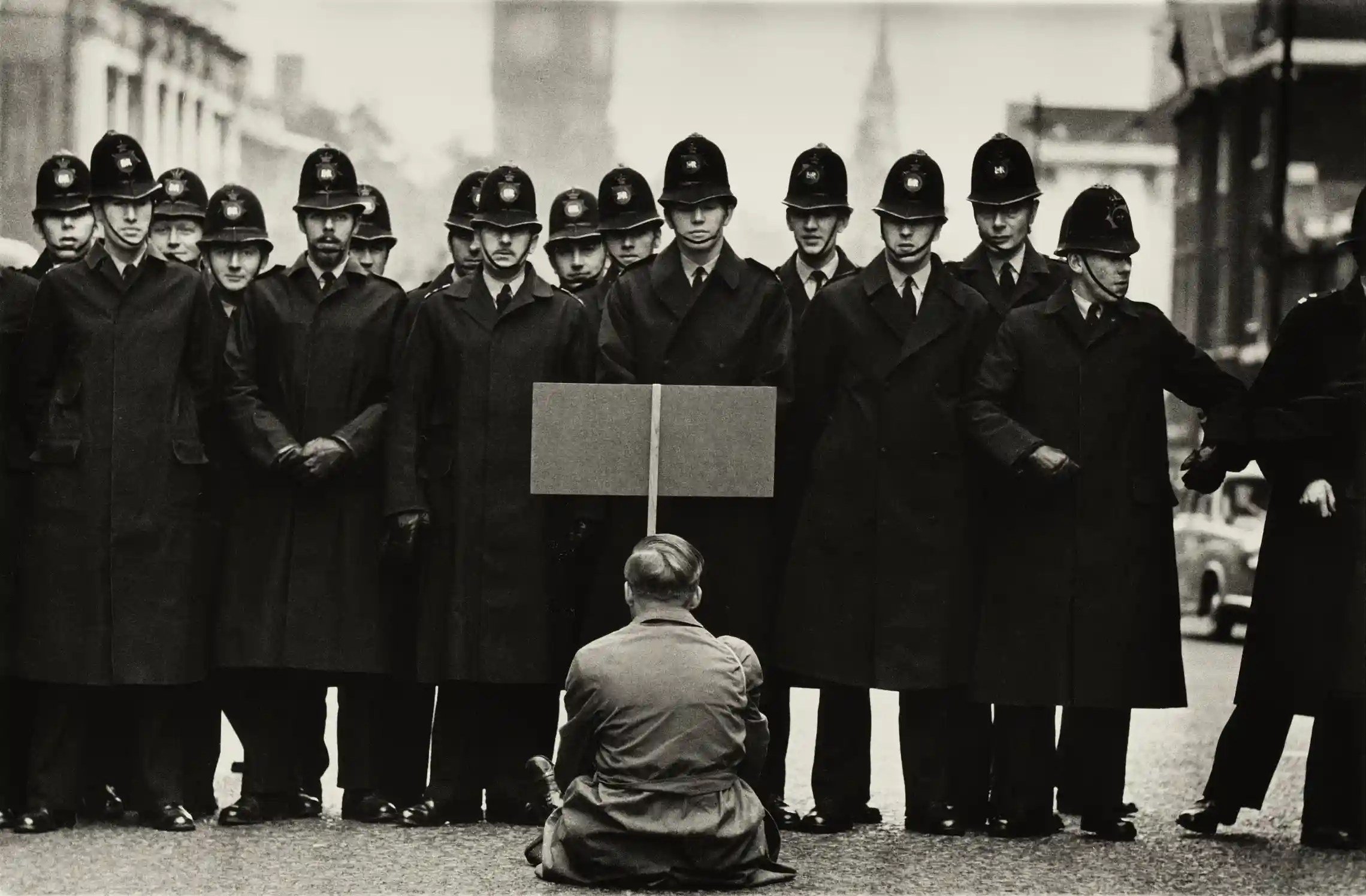
My photograph of the man at Whitehall was for theObserver. I was sent to cover an anti-nuclear demonstration in Trafalgar Square during the Cuban missile crisis. The man had broken away from the crowd and made his way down Whitehall – the seat of power. The police threw a line out across the road very quickly, knowing other protesters would follow him.
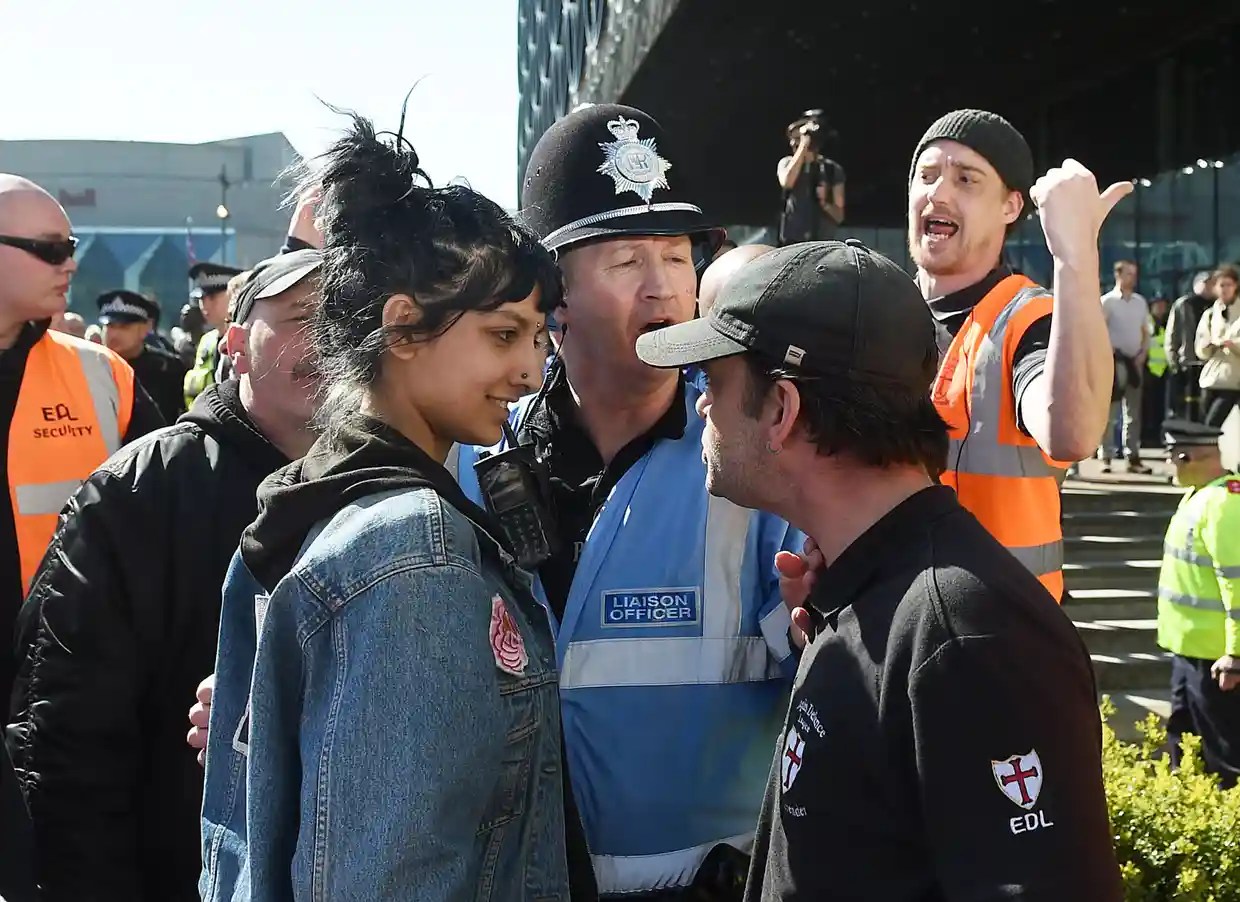
Saffiyah Khan squares off with EDL demonstrator Ian Crossland in Birmingham in 2017.Embrace the Base, Greenham Common, 1982
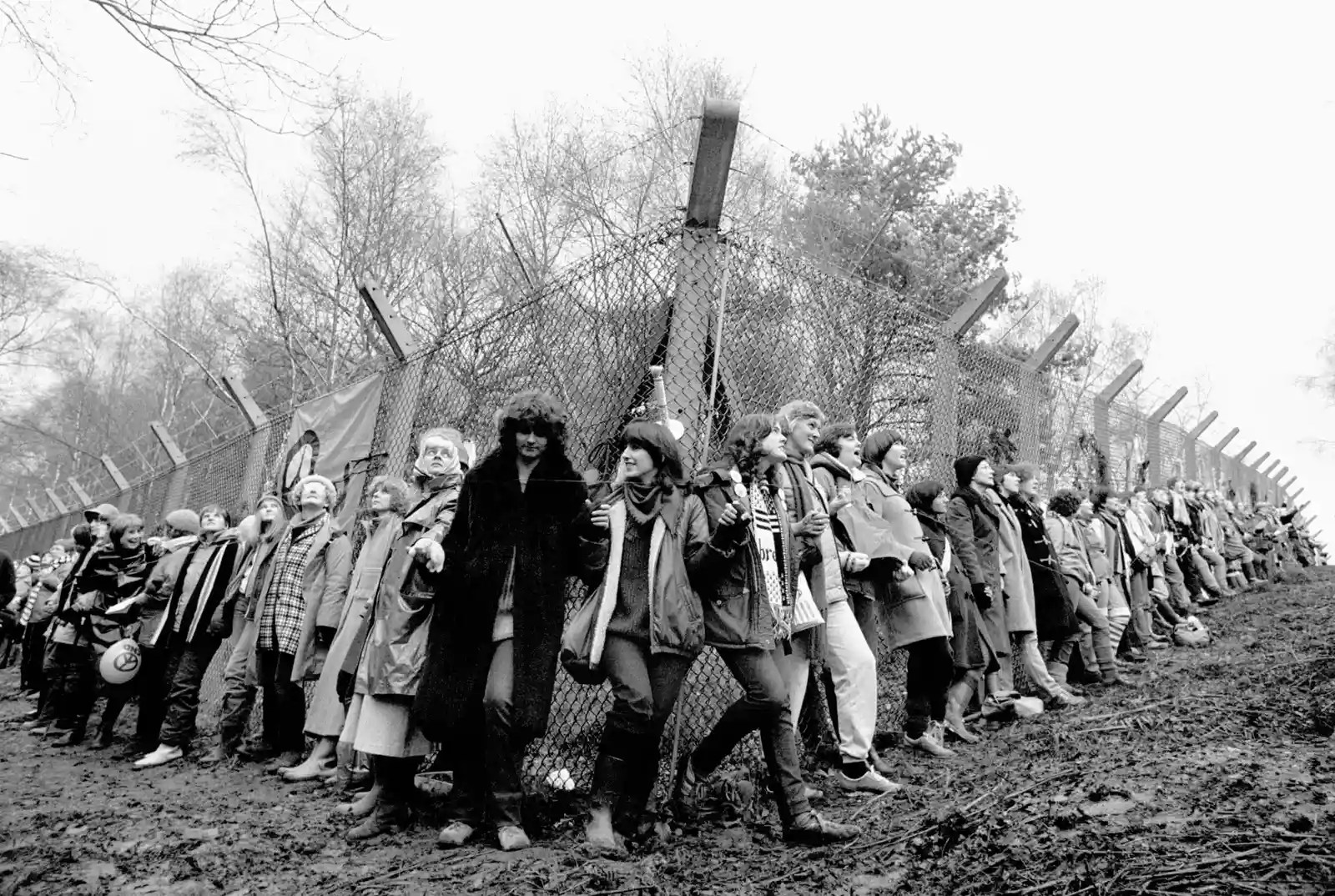
The Greenham Common Women’s Peace Camp, an anti-nuclear encampment that ran from 1981 to 2000, was the largest female-led protest movement since the suffragettes. The most famous event at the camp was Embrace the Base: a protest marking the first anniversary of Nato’s decision to store nuclear missiles at the RAF airfield in Berkshire. On 12 and 13 December 1982, more than 30,000 women came together to hold hands and encircle the nine-mile perimeter fence of Greenham.
Bloody Sunday, 1972
Fulvio Grimaldi was one of the few journalists present when British soldiers opened fire on protesters in Derry, killing 13 people. His image of panicked civilians carrying the body of teenager Jackie Duddy became the iconic image of the massacre. FB
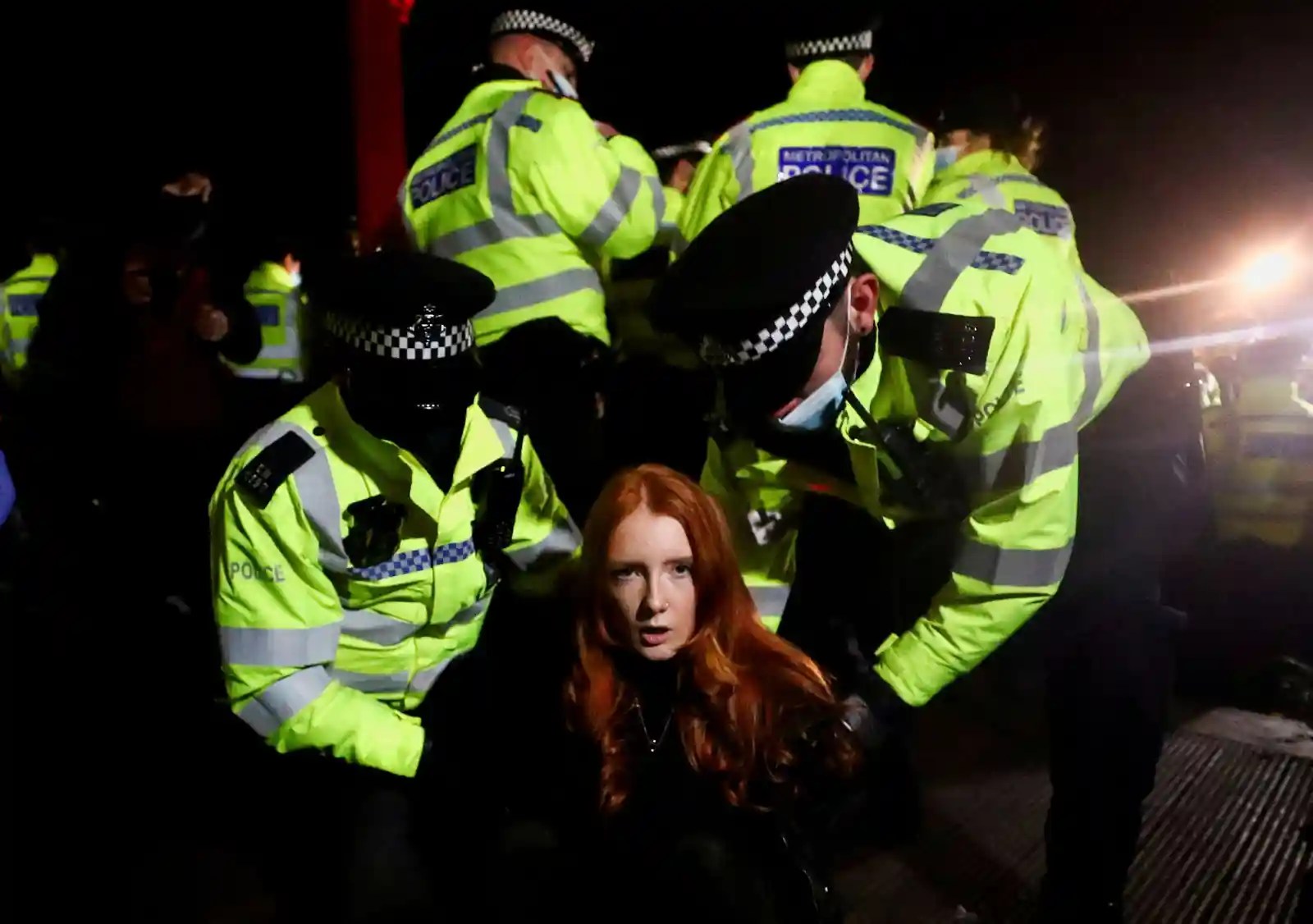
Patsy Stevenson is arrested at the vigil for Sarah Everard, 2021
“You could literally feel the emotion in the air. It was a very heavy feeling,” Patsy Stevenson says of the vigil on London’s Clapham Common on 13 March 2021. Hundreds had gathered to mourn Sarah Everard, who had been abducted, raped and murdered by Metropolitan police officer Wayne Couzens. “Often as women we’re told to stay indoors when things like this happen. It was one of those moments where it was like, no, we don’t want to stay silent any longer,” Stevenson says.
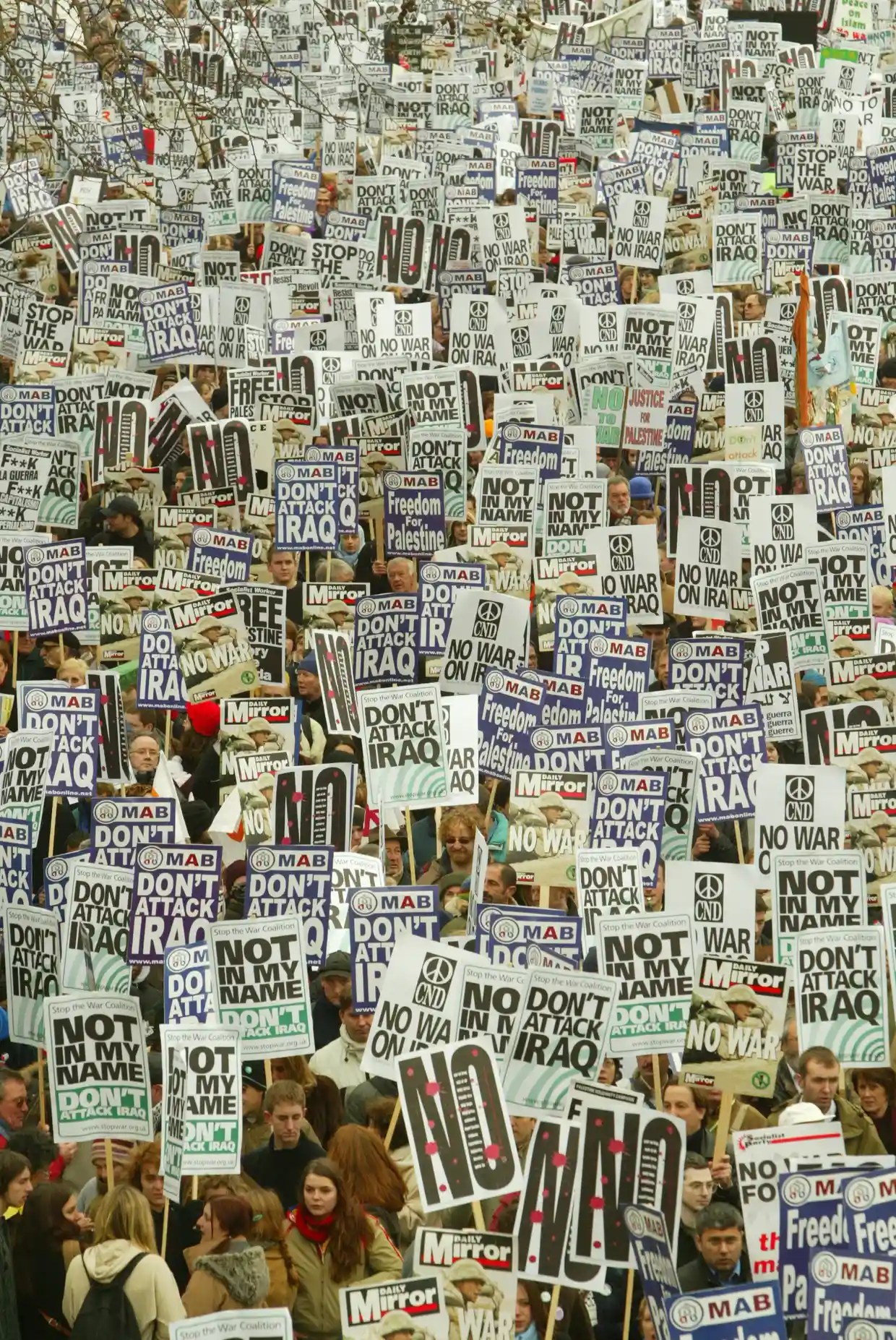
Brits with banners London says no to the invasion of Iraq, 2003
People in more than 600 cities across the world took to the streets on 15 February 2003 to express their opposition to the planned US-led invasion of Iraq. These demonstrations are said to be the largest coordinated protest event in history. This photograph of a sea of banners at the march in London captures the scale of the proceedings. Despite the groundswell of public opposition, the war in Iraq began just over a month later. GS
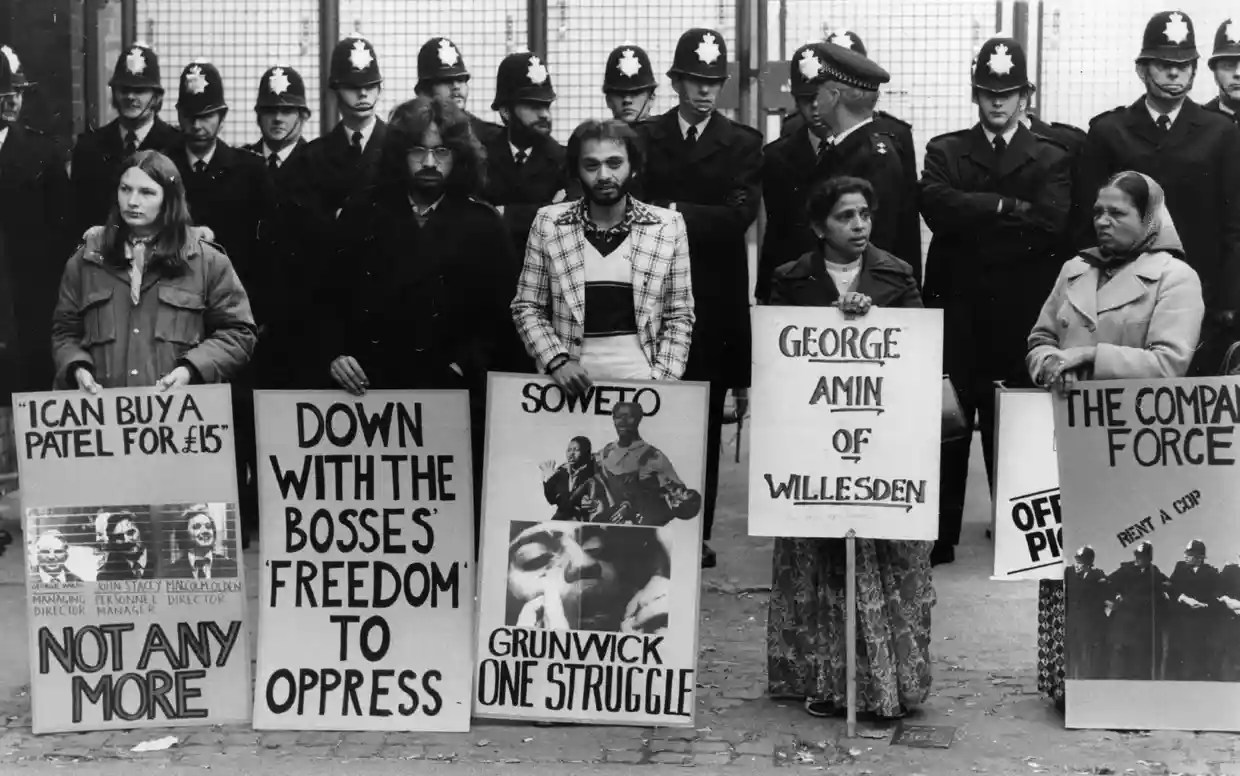
Grunwick strike, 1977
In the late 70s, Jayaben Desai (second from right) led a workers’ strike at the Grunwick Film Processing factory in Willesden, advocating for better working conditions. Most of the workers, including Desai, were Ugandan Asian women who had been expelled by Idi Amin before settling in the UK. Their strike gained wide support: postal workers refused to take mail to and from the factory, and even Arthur Scargill joined the picket line. The writer Amrit Wilson, who covered the protest, remembers Desai as “very persuasive … She also understood patriarchy, which was central to the strike.” FB
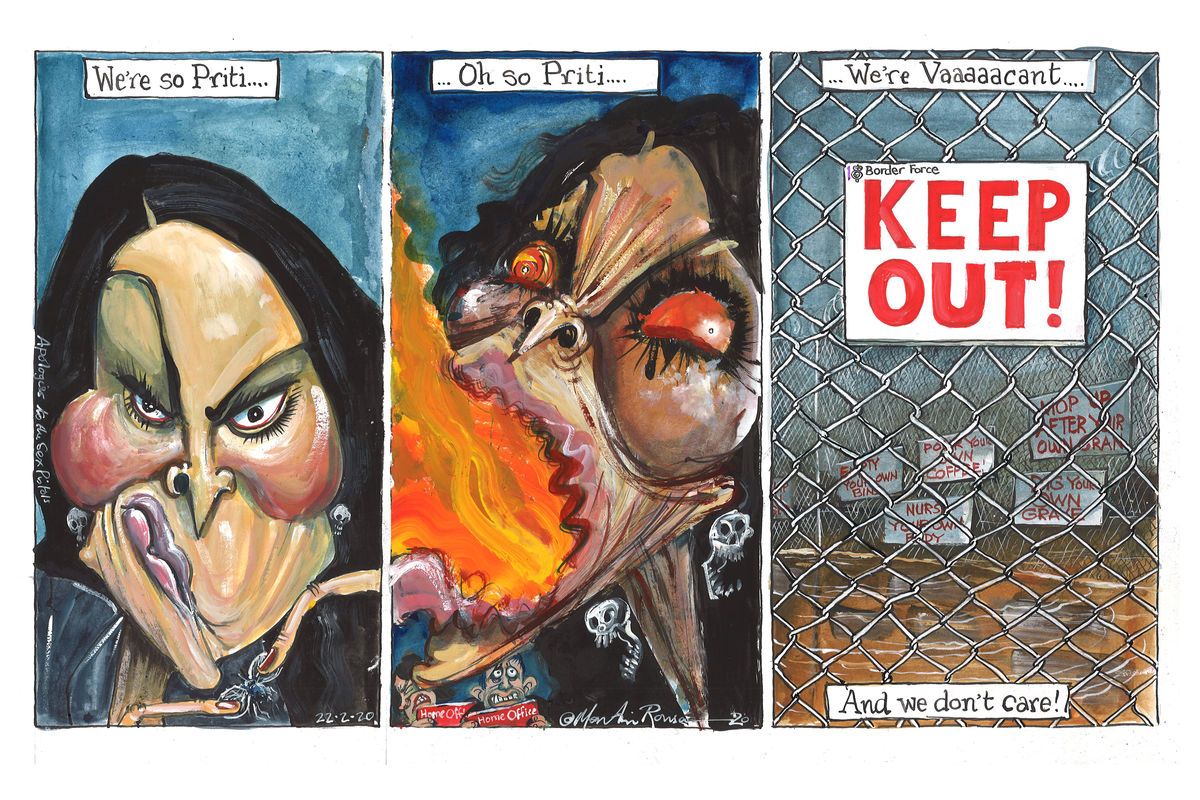
There’s no point in asking You’ll get no reply Oh just remember I don’t decide I got no reason it’s all too much You’ll always find us Out to lunch
Oh we’re so pretty Oh so pretty We’re vacant Oh we’re so pretty Oh so pretty Vacant
Don’t ask us to attend ‘Cos we’re not all there Oh don’t pretend ‘cos I don’t care I don’t believe illusions ‘cos too much is real So stop your cheap comment ‘Cos we know what we feel
Oh we’re so pretty Oh so pretty We’re vacant Oh we’re so pretty Oh so pretty Vacant
Oh we’re so pretty Oh so pretty Ah but now And we don’t care
There’s no point in asking You’ll get no reply Oh just remember I don’t decide I got no reason it’s all too much You’ll always…
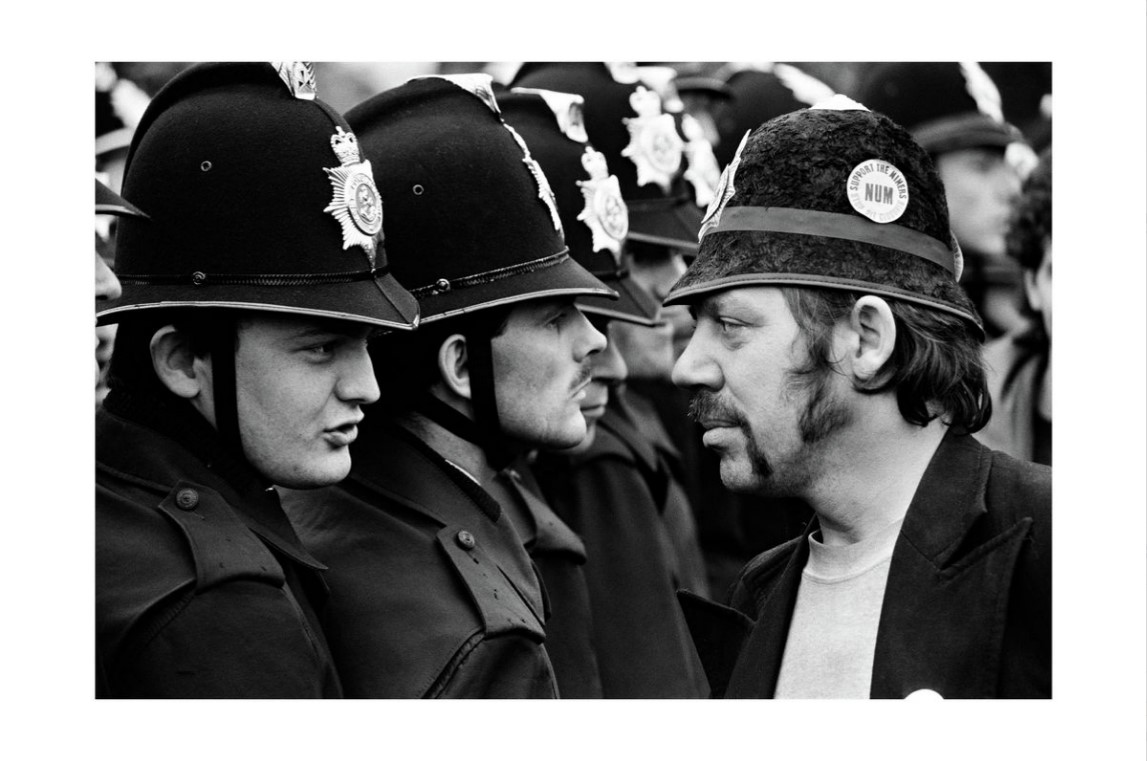
Paul Castle (far left) and George ‘Geordie’ Brealey (right) at Orgreave in 1984. Photograph: Don McPhee
It is one of the abiding images of the 1984 coal strike – Guardian photographer Don McPhee’s picture of a picketing miner facing up to an officer.
The two men were on opposite sides of one of the bitterest industrial disputes of the 20th century. Golf balls, stones and sharpened coins had been flying, police horses were about to charge, and the leader of Britain’s striking mineworkers, Arthur Scargill, had been arrested in that same field outside Orgreave cokeworks, near Rotherham, South Yorkshire, a few days earlier.
We were there…
The 200 moments that made the Guardian – this was #1